



Lot n° 144
Estimation :
80000 - 100000
EUR
Result with fees
Result
: 84 110EUR
Pierre CARTELLIER (1757-1831) - Lot 144
Pierre CARTELLIER (1757-1831)
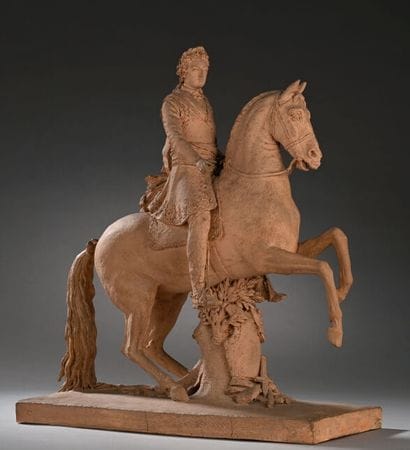
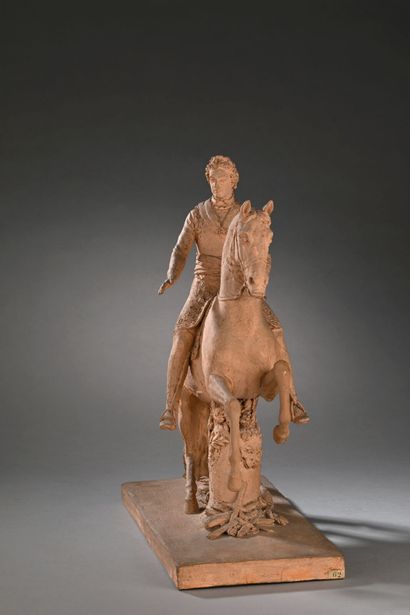
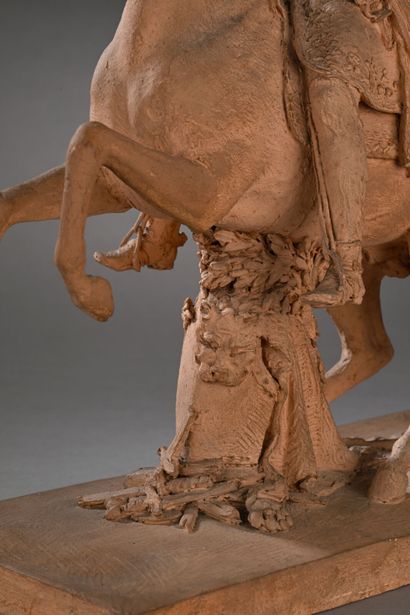
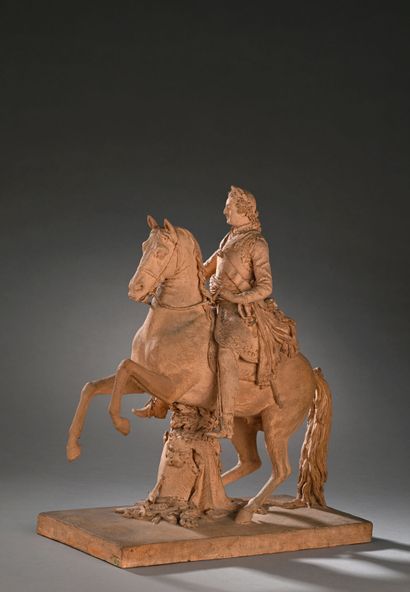
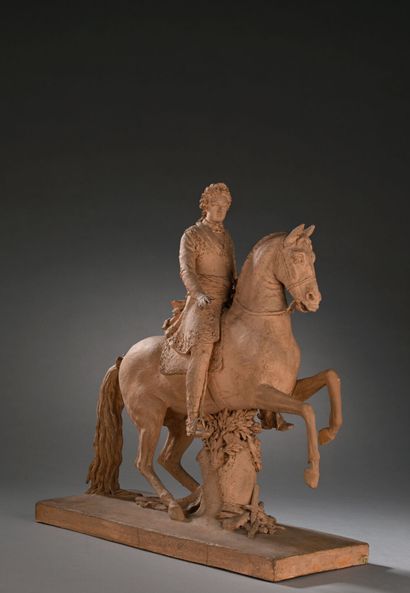
Louis XV at full gallop
1817
Model in patinated terra cotta, first draft
(Minor accidents)
Height 36 cm; Width: 32 cm; Depth: 14 cm
Provenance: Pierre Cartellier, by descent
Related works :
- Pierre Cartellier, Louis XV au pas, deuxième projet maquette en cire second wax model project, 1825, H. 19 cm, noted as preserved in a private collection in the Essai de Catalogue raisonné, no. 37, p. 29 ;
- Pierre Cartellier, Louis-Messidor Petitot, Charles Crozatier, Louis XIV, 1835, patinated bronze statuette, H. 139 cm, Château de Versailles, n° inv.MV 6880 ;
- Pierre Cartellier, Louis Petitot, Statue équestre de Louis XIV, bronze, cast by Crozatier between 1831 and 1834, Place d'Armes, Château de Versailles.
Bibliography:
- Gérard Hubert, "L'œuvre de Pierre Cartellier, sculpteur, essai de catalog raisonné", in Bulletin de la Société d'Histoire de l'Art français, July-August 1980, pp.1-44 ; notice 37, pp. 29-30 ;
- Gérard Hubert, Pierre Cartellier, statuaire. Oeuvres et documents inédits. Ancien Régime, Révolution et Consulat, 1976, pp. 313 ff.
This original work bears witness to the evolution of one of the largest monument projects commissioned under the Restoration. The highly accomplished terracotta model, produced in 1817, corresponds to the first project by sculptor Pierre Cartellier in response to King Louis XVIII's commission for a monumental equestrian statue in honor of his grandfather, King Louis XV, for the Place de la Concorde, to replace Bouchardon's work.
The artist, introduced by Vivant Denon, had established himself as one of the imperial family's official sculptors. He continued his career without difficulty under the Restoration, adapting to political changes and building on his well-established reputation. In addition to his distinction as Chevalier de l'Ordre de la Légion d'Honneur since 1808, his appointment to the Académie des Beaux-Arts in 1810 and his professorship at the École des Beaux-arts de Paris in 1816 ensured this influence.
Louis XVIII therefore turned to an official, renowned sculptor to create a monument to celebrate the return of the Bourbons to the throne of France and establish dynastic continuity.
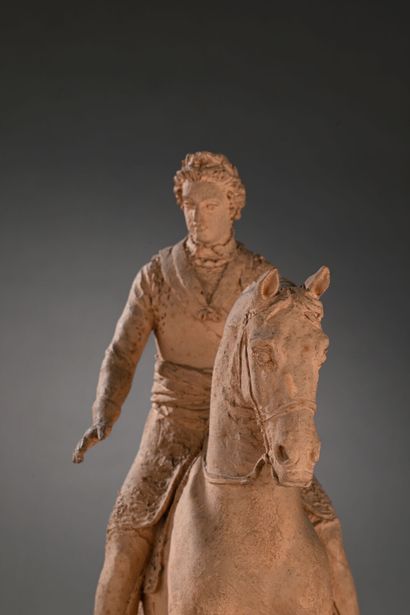
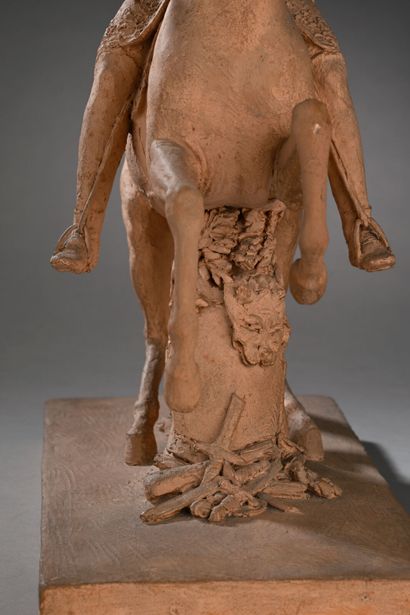
In keeping with the tradition of the royal equestrian portrait, a symbol of power dating back to Antiquity, Pierre Cartellier chose a composition that was both classical and innovative. King Louis XV is shown on a horse caracoling above broken trophies, his head laurelled, wearing a French-style embroidered coat and cuirass, the Grand Cordon du Saint-Esprit in saltire and another order in tie, and a sash floating over the horse's rump. No doubt inspired by Bernini's equestrian statue, Cartellier, like his rival Bosio, who was responsible for the equestrian statue of Louis XIV on the Place des Victoires, depicted the king as a victorious hero at full gallop.
The monument, transcribed in marble, was to have been completed for an inauguration scheduled for November 4, 1829, but the project was quickly modified due to the impossibility of finding a block of Carrara marble suitable for the initially planned height of 525 cm. In 1825, Cartellier proposed making the statue in another material, bronze. He then had to transform the mount into the more classical attitude of a horse at a walk, due to the difficulties created by the casting technique. In February 1826, a new small quarter-scale model showing the modified horse stance was completed (now lost). Meanwhile, King Charles X commissioned another sculptor, Jean-Pierre Cortot, to create a statue of Louis XVI on the site originally intended for Cartellier's statue of Louis XV.
A new location, the Rond-point des Champs-Élysées, was finally chosen in 1828, and a pedestal was commissioned from the architect Alphonse de Gisors, which Cartellier rejected. Cartellier completed the large model in December 1829, and his pupil Crozatier was about to cast the sculpture when the July Revolution broke out. Unfortunately, Cartellier broke his already advanced model of the rider, while the horse remained in the mold. Cartellier died on June 12, 1831, leaving his monument unfinished.
In 1834, the commission in charge of unfinished monuments paid the founder and entrusted the new model of the horseman to Louis-Messidor Petitot, Pierre Cartellier's son-in-law, who had taken over his late father-in-law's business. But when Louis-Philippe, King of the French, transformed the former royal residence into a museum dedicated to "All the glories of France", he changed the project and asked for a portrait of Louis XI.
My orders
Sale information
Sales conditions
Return to catalogue