



Lot n° 143
Estimation :
4000 - 6000
EUR
Result
: NC
Pierre CARTELIER (1757-1831) - Lot 143
Pierre CARTELIER (1757-1831)
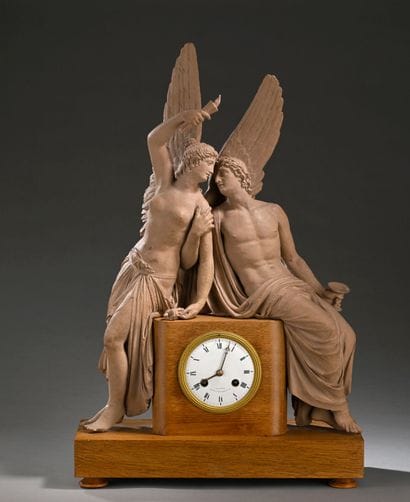
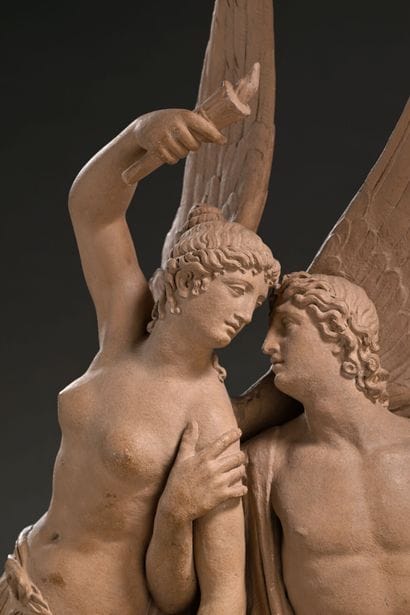
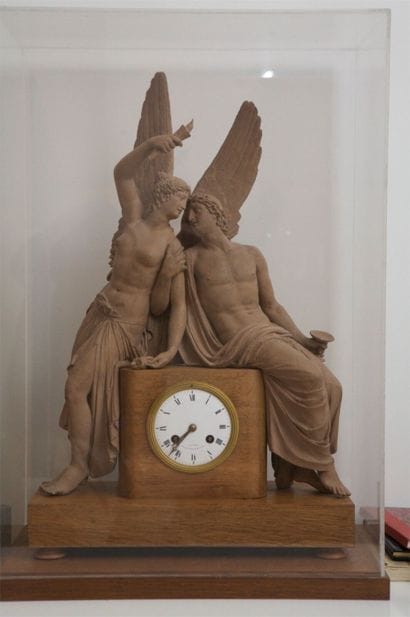
The poet's inspiration
circa 1800-1805
Painted terracotta model mounted on a modern clock
Height : 60 cm ; Width : 40 cm ; Depth : 14 cm
Provenance: Pierre Cartellier, by descent
Bibliography:
- Gérard Hubert, "L'œuvre de Pierre Cartellier, sculpteur, essai de catalog raisonné", in Bulletin de la Société d'Histoire de l'Art français, July-August 1980, pp.1-44 ; notice 39, pp. 39-40 ;
- Gérard Hubert, "Pierre Cartellier, statuaire, œuvres et documents inédits", in Bulletin de la Société d'Histoire de l'Art français, 1976, pp. 317-318.
A former student of Charles-Antoine Bridan, Pierre Cartellier is best known for his official commissions in monumental statuary. Having worked on Marie-Antoinette's projects at the Trianon and Saint-Cloud before the Revolution, he then took part in the transformation of the décor of the Sainte-Geneviève church in 1791. This was the starting point of his encounter with Chaudet and his gradual conversion to the emerging neo-classicism. He then joined the team redesigning the Palais du Luxembourg, and took part in the embellishment of the Palais du Louvre and the great Commission for the Galerie de Diane. His collaboration on some of the twenty-two effigies of orators and generals for the Senate helped place him among the most prominent sculptors, alongside Antoine Chaudet, Joseph Chinard and François-Frédéric Lemot. He was then introduced by Vivant Denon to Louis Bonaparte as part of the first major imperial statuary commission, consisting of full-length portraits of the Empire's leading dignitaries. The Director General of the Musée Napoléon suggested to Louis Bonaparte "an artist who was worthy of his talents".
This charming group, later mounted on a modern clock, is a reminder that the sculptor also produced works in the decorative arts. This terracotta model depicts the winged genius of poetry in the form of a half-naked young woman leaning towards the poet, illuminating him with her torch. His neoclassical style, which he gradually adopted at the turn of the 18th century, must date from the years 1800-1805. However, no finished clock with a bronze group based on this model is known to exist.
Expert : Cabinet LACROIX & JEANNEST Sculp. & Collec.
My orders
Sale information
Sales conditions
Return to catalogue